
AI is no longer a side project in healthcare. It is becoming part of daily clinical and business operations. In 2026, about 75% of U.S. health systems use at least one AI application, up from 59% a year earlier. Physician adoption has grown even faster, with 66% of U.S. doctors using health AI in 2024, up from just 38% the year before. Patients expect faster answers. Doctors want less paperwork. Hospitals want lower costs. Traditional software cannot keep up with these demands anymore, because it was never built to learn from data or adapt on its own.
That is why more healthcare organizations are turning to AI product engineering services to build tools that actually solve clinical and operational problems, instead of just digitizing old paper processes. This blog explains what AI product engineering means, why healthcare needs it, and how it is changing patient care, diagnostics, and hospital operations. You will also learn about MVP development, product discovery, and what it takes to build AI-native product development the right way, backed by real data from across the industry.
What Is AI Product Engineering?
AI product engineering is the process of designing, building and scaling software products powered by artificial intelligence. It is different from regular AI software development. Software development often means adding an AI feature to an existing app. AI product engineering means building the entire product around AI from day one, including data pipelines, model training, and user experience. The process moves through clear stages: ideation, data preparation, model development, product design, testing, deployment, and continuous optimization. Each stage feeds into the next, so the final product is reliable, safe, and ready for real clinical use, not just a demo. Product discovery sits at the center of this process. Before any code is written, teams talk to clinicians, map existing workflows, and figure out where AI can genuinely help instead of adding noise. This step alone often decides whether a healthcare AI product succeeds or gets abandoned after launch.
Why Healthcare Needs AI Product Engineering
Healthcare today faces serious pressure. Administrative work is piling up. Physician burnout is rising, and staff shortages make it worse. Patient volumes keep growing while budgets stay tight. On top of that, patient data is scattered across different systems, diagnoses get delayed, and compliance rules keep changing. These problems cannot be solved by writing more code alone. They need smart systems that learn from data, spot patterns early, and reduce manual work. AI product engineering builds exactly this kind of software. It automates repetitive tasks, flags high-risk patients sooner, and gives clinicians tools that fit into their existing workflow instead of adding more work. Nearly 90% of healthcare executives now report using AI in at least one clinical or operational function, which shows this shift is already mainstream, not experimental.
Key Ways AI Product Engineering Is Transforming Healthcare
AI is now touching almost every part of the patient journey, from the first appointment to long-term recovery. Below are the areas where the impact is most visible today.
Smarter Clinical Decision Support
AI-assisted diagnosis tools help doctors catch conditions earlier by scanning patient data for risk patterns humans might miss. These systems offer evidence-based recommendations pulled from thousands of similar cases, not just guesswork. This speeds up clinical decisions during time-sensitive moments. Research shows AI-supported hospitals saw a 42% drop in diagnostic errors compared to hospitals without AI tools. That is a direct improvement in patient safety, not just an efficiency gain.
Intelligent Medical Documentation
Ambient AI scribing tools listen during patient visits and turn speech into structured notes automatically. They generate SOAP notes, saving doctors hours of typing after each appointment. AI scribe tools cut physician charting time by 40 to 45%. Less time on documentation means more time actually looking at the patient, which improves both care quality and doctor satisfaction. This is one of the fastest-growing use cases in hospitals right now.
Predictive Analytics
Predictive models scan patient data to flag early signs of disease before symptoms get serious. They can predict hospital readmission risk and sepsis onset hours before a human would notice. At a population level, these same models help health systems spot trends across thousands of patients, guiding where to focus prevention efforts. Nearly two in three U.S. hospitals now use AI-driven predictive models for exactly this kind of forecasting.
Personalized Patient Care
No two patients respond to treatment the same way. AI product engineering makes it possible to build tools that recommend personalized treatment plans and care pathways based on a patient’s specific history. It can suggest medication adjustments and flag drug interactions automatically. Combined with remote patient monitoring, doctors can track chronic conditions from a distance and step in only when something looks off, instead of waiting for the next scheduled visit.
Workflow Automation
A lot of hospital time goes into tasks that have nothing to do with actual patient care. AI can automate appointment scheduling, patient triage, insurance verification, and claims processing. This cuts down on manual paperwork and human error. Administrative automation like this frees up staff to focus on patients instead of forms. AI is projected to cut U.S. administrative healthcare costs by $20 billion a year.
AI-Powered Medical Imaging
Medical imaging is one of the most mature AI use cases in healthcare. AI models analyze X-rays, CT scans, and MRIs to spot abnormalities faster than manual review alone. This speeds up radiology reporting and improves diagnostic accuracy. Around 74% of U.S. hospitals already use AI-powered diagnostic tools in radiology departments, and some AI models reach up to 94% accuracy in tumor detection.
Virtual Healthcare Assistants
AI chatbots now handle a lot of routine patient interaction. They answer common questions, send medication reminders, run basic symptom checks, and follow up after appointments automatically. This keeps patients engaged between visits without adding extra work for clinical staff. For patients managing chronic conditions, these small nudges can make a real difference in whether they stick to their treatment plan.
Benefits of AI Product Engineering for Healthcare Organizations
The impact of AI product engineering reaches every group involved in care. For providers, it means less burnout, better documentation, and faster day-to-day workflows. For patients, it means quicker diagnosis, more personalized care, and better engagement through tools built around their needs. For healthcare businesses, it means lower operational costs, higher staff productivity, and stronger ROI. In fact, healthcare organizations report an average return of $3.20 for every $1 invested in AI, often within 12 to 18 months. These are not small, one-off wins. They compound across departments once the right products are in place.
Essential Components of AI Healthcare Product Engineering
Building AI products for healthcare requires more than just a good model. Data engineering covers EHR integration, HL7/FHIR interoperability, and clean data pipelines that feed accurate information into the system. AI models span machine learning, deep learning, NLP, computer vision, and generative AI, each suited to different clinical tasks. Cloud infrastructure supports scalable deployment and real-time processing so tools work reliably under real hospital loads. Security and compliance cover HIPAA; GDPR, where relevant; encryption; and access control, since patient data protection is non-negotiable. Finally, continuous monitoring tracks model performance, checks for bias, and manages retraining as new data comes in. Skipping any one of these pieces usually shows up later as a compliance gap, a broken integration, or a model that quietly loses accuracy over time.
Real-World Use Cases Across Healthcare
AI product engineering shows up differently depending on the setting. In hospitals, it optimizes clinical workflows, supports documentation, and manages patient flow. In telehealth, it powers virtual consultations, AI-driven triage, and smart scheduling. In medical billing, it automates coding, supports revenue cycle management, and speeds up claims review. In diagnostics, it drives imaging analysis, predictive diagnosis, and pathology support. And in pharmaceutical companies, AI product engineering is accelerating drug discovery, clinical trial design, and research automation, with the drug discovery technology market expected to reach $77.6 billion in 2026.
Challenges in AI Product Engineering for Healthcare
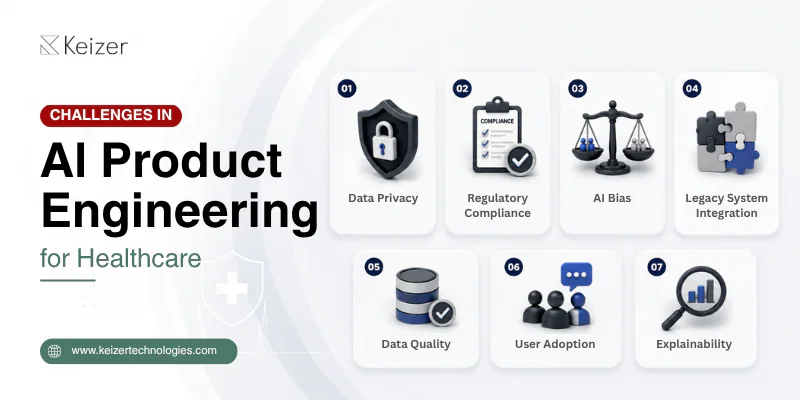
Building AI for healthcare is not simple. Data privacy is a constant concern, and the fix is strong encryption plus strict access control built in from the start. Regulatory compliance with HIPAA and similar laws requires legal and technical teams working together from day one, not as an afterthought. AI bias can creep in from unbalanced training data, so teams need diverse datasets and regular bias audits. Legacy system integration is often messy, and using interoperable standards like FHIR and HL7 makes it manageable. Data quality issues get solved through proper data engineering and validation pipelines. User adoption improves when clinicians are involved in design, not just testing. And explainability matters most in healthcare, so models need to show their reasoning, not just an output. Interestingly, around 46% of healthcare organizations are still in early-stage generative AI implementation, which shows most of the industry is still working through these exact challenges.
Best Practices for Successful AI Healthcare Product Engineering
The best AI healthcare products start with a clearly defined clinical problem, not a vague idea of “adding AI.” Teams should build with clinicians in the loop throughout product discovery, so the tool actually fits real workflows. Security and compliance need to be prioritized early, not bolted on later. Using interoperable standards like FHIR and HL7 avoids painful integration problems down the line. Products should be designed for scalability from the first version, with continuous performance monitoring built in. Every AI model needs validation against real-world clinical data, not just lab conditions. And throughout it all, user experience for doctors and nurses should stay a top priority, since a tool nobody wants to use has no value at all.
Future Trends in AI Product Engineering for Healthcare
The next wave of healthcare AI is already taking shape. Generative AI and agentic AI are moving from experiments into daily clinical tools that can act, not just answer questions. Ambient intelligence is spreading beyond documentation into full clinical environments. Digital twins are letting researchers model patient outcomes before trying treatments in real life. AI copilots for clinicians and autonomous clinical workflows are becoming more common in hospital pilots. Edge AI is bringing intelligence directly into medical devices, cutting latency for urgent decisions. And multimodal AI, which combines text, images, and other data types, is making diagnosis tools far more accurate than single-input systems.
How Keizer Technologies Helps Build AI-Powered Healthcare Products
Keizer Technologies works with healthcare organizations to turn AI ideas into working products, from the first discovery session through MVP development and full-scale deployment. The team brings deep healthcare software development expertise combined with HIPAA-compliant AI solutions built for real clinical environments. This includes EHR integration, custom AI model development, and cloud-native architectures designed to scale as patient volumes grow. Whether it is modernizing an existing application or building AI-native product development from scratch, Keizer Technologies supports the full journey with ongoing support and optimization after launch, not just a one-time delivery.
Conclusion
AI product engineering is changing nearly every part of healthcare, from how doctors document visits to how hospitals predict patient risk. Organizations that invest in intelligent healthcare products today will be better positioned to improve patient outcomes, cut costs, and adapt as new technology arrives. The data backs this up: rising adoption rates, strong ROI, and real reductions in diagnostic errors all point the same direction.
The global AI in healthcare market is expected to reach roughly $50.7 billion in 2026, and this growth is not slowing down anytime soon. Partnering with an experienced AI product engineering services provider can shorten the distance between a good idea and a scalable healthcare solution that actually works in the real world, from the first product discovery conversation to a fully deployed, AI-native product used by thousands of patients every day.
